Planning for Dissemination, Decisions & Action
The objective of the final session of the workshop is to identify concrete actions to take forward the work you have completed. As you have been preparing and interpreting your analyses, you have been encouraged to think about the full cycle of data-driven decision-making.
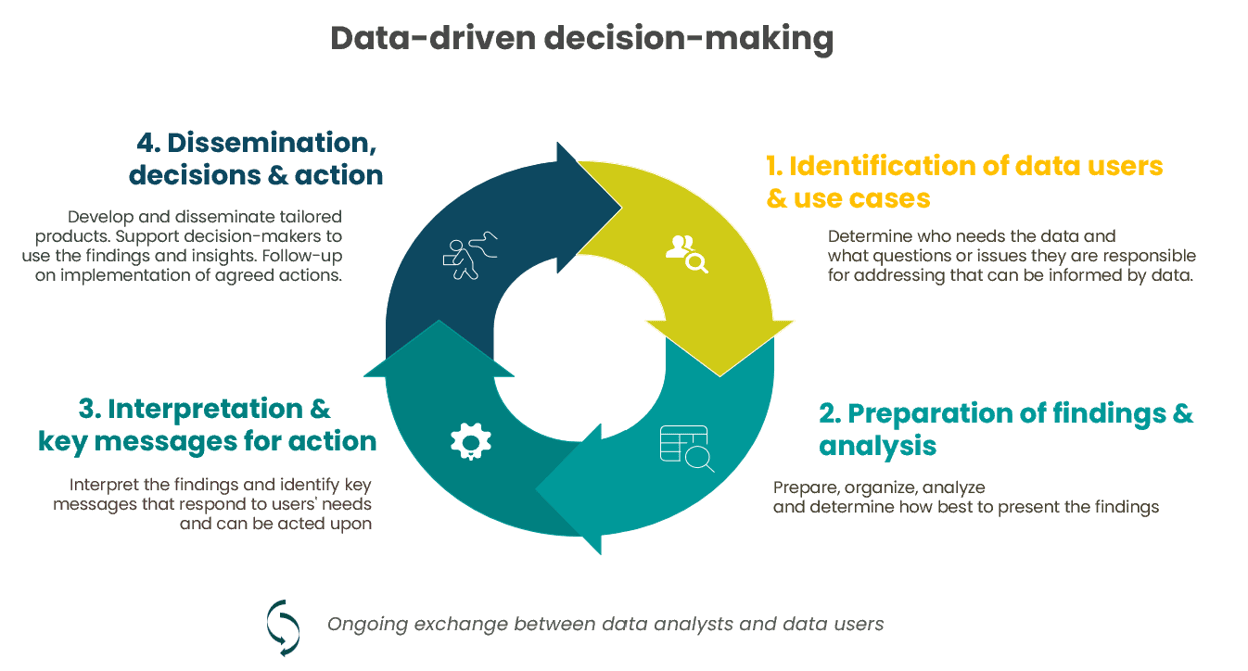
This starts with identifying the data users and understanding the questions or issues they aim to address, and then preparing the analysis, interpretation and key findings that would be most useful for addressing those questions or issues.
Information products and dissemination strategies should be tailored to align with users’ preferences and should be supplemented with support to decision-makers in using the analysis and following up on agreed actions.
Key Considerations
- Identify use cases and audiences
- Use appropriate dissemination platforms
- Integrate into routine decision-making forums
- Link to Ministry of Health reviews and reporting processes
Purpose of the Activity
These activities outline how analysis outputs can be translated into action, capacity strengthening, and further research within the CD2030 framework.
Supporting data use and action
View examples
-
Present findings, interpretation and key insights to the country RMNCAH platform and related technical working groups for them to review and interpret. Support them to identify opportunities to take action based on data and evidence - for example, address gender or geographic inequities, test pilots with implementation research or evaluation, advocate for policy change or resources, etc.
-
Include analysis as part of evidence base to inform the development of new RMNCAH-N strategy, a mid-term review and an evaluation, if any of these are underway.
-
Produce an article or analytical brief for targeted audiences with key learning, takeaways, and proposed actions following the workshop, as an entry point for follow-up.
Building capacity
View examples
-
Carry out cascade training at national and district levels on the concepts, interpretation, and use of specific analyses, through the country Countdown collaboration.
-
Hold sessions to sensitize national bureau of statistics staff on Countdown methodology to build ownership.
-
Share the concepts and findings of health facility data quality assessment with HMIS and M&E staff to build their understanding and as an opportunity for strengthening routine systems for data quality.
-
Build HMIS and M&E staff capacity to understand the relevance of gender and equity-related indicators and analyses.
-
Build capacity of staff to incorporate some of the new analytical techniques and approaches into dashboards, policy briefs, statistical reports, etc.
Identifying needs for further analysis
View examples
-
Identify opportunities for implementation research to address bottlenecks or to inform potential scale-up/replication of successes based on findings from the analysis.
-
Identify opportunities for further research or analysis in order to better understand trends in gender and equity that were observed in the analysis and to inform options for action.